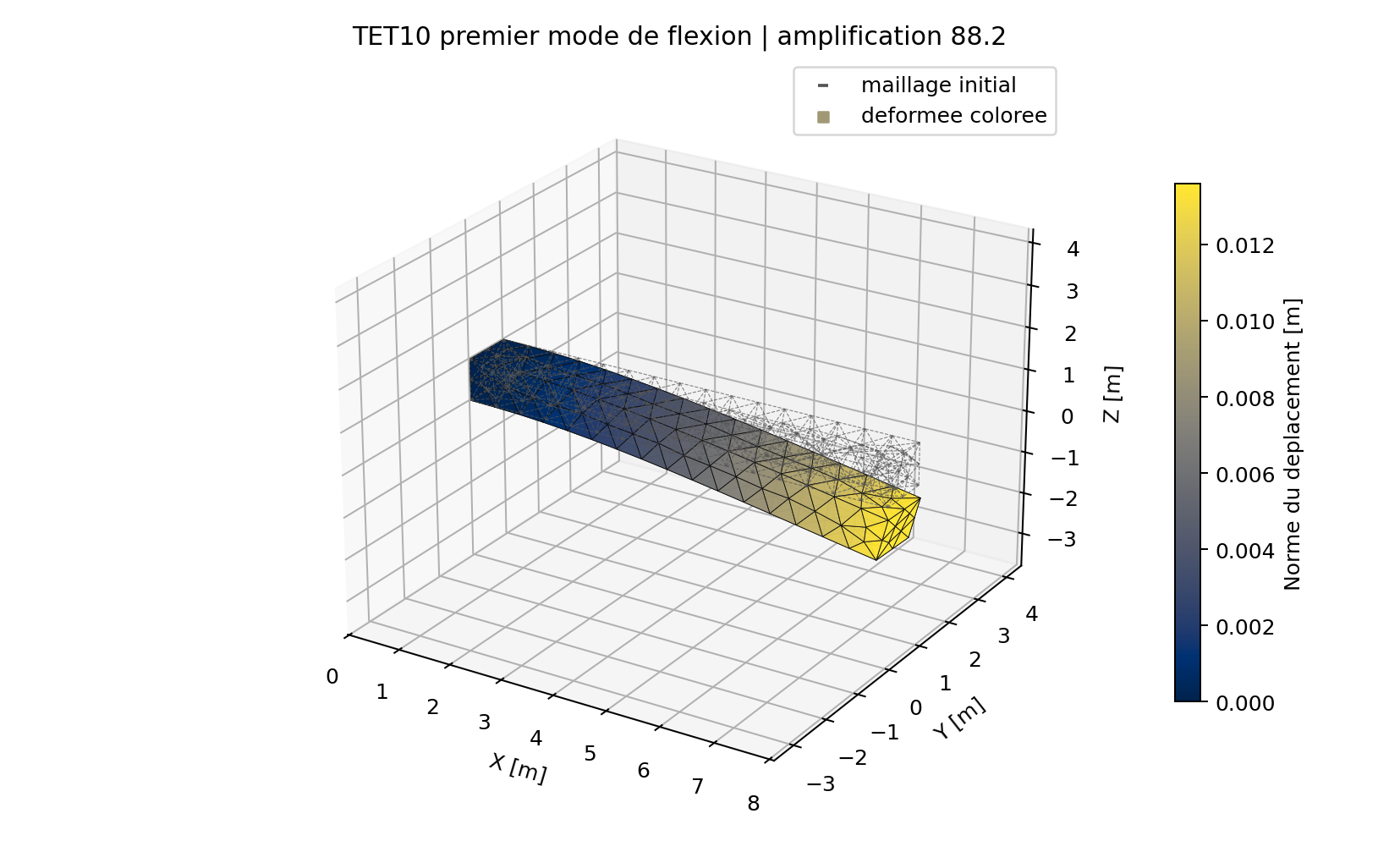
The normal sparse eigenroute calls ARPACK/eigsh; dense conversion is explicit and limited by active DOFs.
01 Model and scope
The sparse route extracts only selected generalized eigenpairs, often around a spectral shift. Dense conversion stores all matrix entries and costs roughly O(n²) memory and O(n³) work, so the active-DOF cap is part of the method boundary.
Route assumptions and calculation checks
- Mode count, spectral shift, tolerance, iteration limit, and dense DOF cap are input parameters.
- ARPACK non-convergence, excessive residual, or degraded mass orthogonality is not a pass.
- Rotating QEP uses a different dense complex solve and remains experimental.
Useful foundations and prerequisites
02 Essential equations and symbols
Definitions and conventions
- Generalized structural eigenproblem.
- Requested number of modes.
- Spectral shift used by the sparse extraction.
- Number of active degrees of freedom.
03 Step by step derivation
Follow the assumptions, equations and discrete operations in order. The full explanation stays visible.
1 · Choose a sparse extraction or a bounded dense route
The modal problem is generalized: Kφ=λMφ. Sparse extraction requests a limited set of eigenpairs near a target shift; it avoids constructing a full dense matrix. Dense conversion is explicit and guarded by an active-DOF cap.
2 · Understand why dense size changes quickly
A dense n×n matrix stores n² entries, while a dense eigensolve requires work that grows cubically with n. The cap is therefore part of the solver contract and protects memory/runtime; it is not a cosmetic configuration option.
3 · Check the returned spectrum
Verify convergence flags, eigenpair residuals, requested mode count, positive mass, and mass orthogonality. A sparse solver that returns a partial set or a loose residual must report that outcome. Shift selection influences which part of the spectrum is extracted.
4 · Keep the rotating QEP separate
The rotating quadratic pencil contains a gyroscopic term and generally complex eigenpairs. It uses a distinct bounded dense route; classical ARPACK generalized symmetric settings and qualification claims do not transfer to that problem.
04 Algorithm and implementation
This sheet provides explanatory references rather than an inline source excerpt. Use the labeled sources to inspect the precise boundary.
05 Verification and limitations
DENSE ROUTE SIZE-LIMITED
The formulation and its explanatory checks do not by themselves establish a qualified application domain. Consult the capability matrix and the applicable recorded case.
See this method in a calculation.
Each case keeps its mesh, measured quantities, source record and limitations attached to the result.